
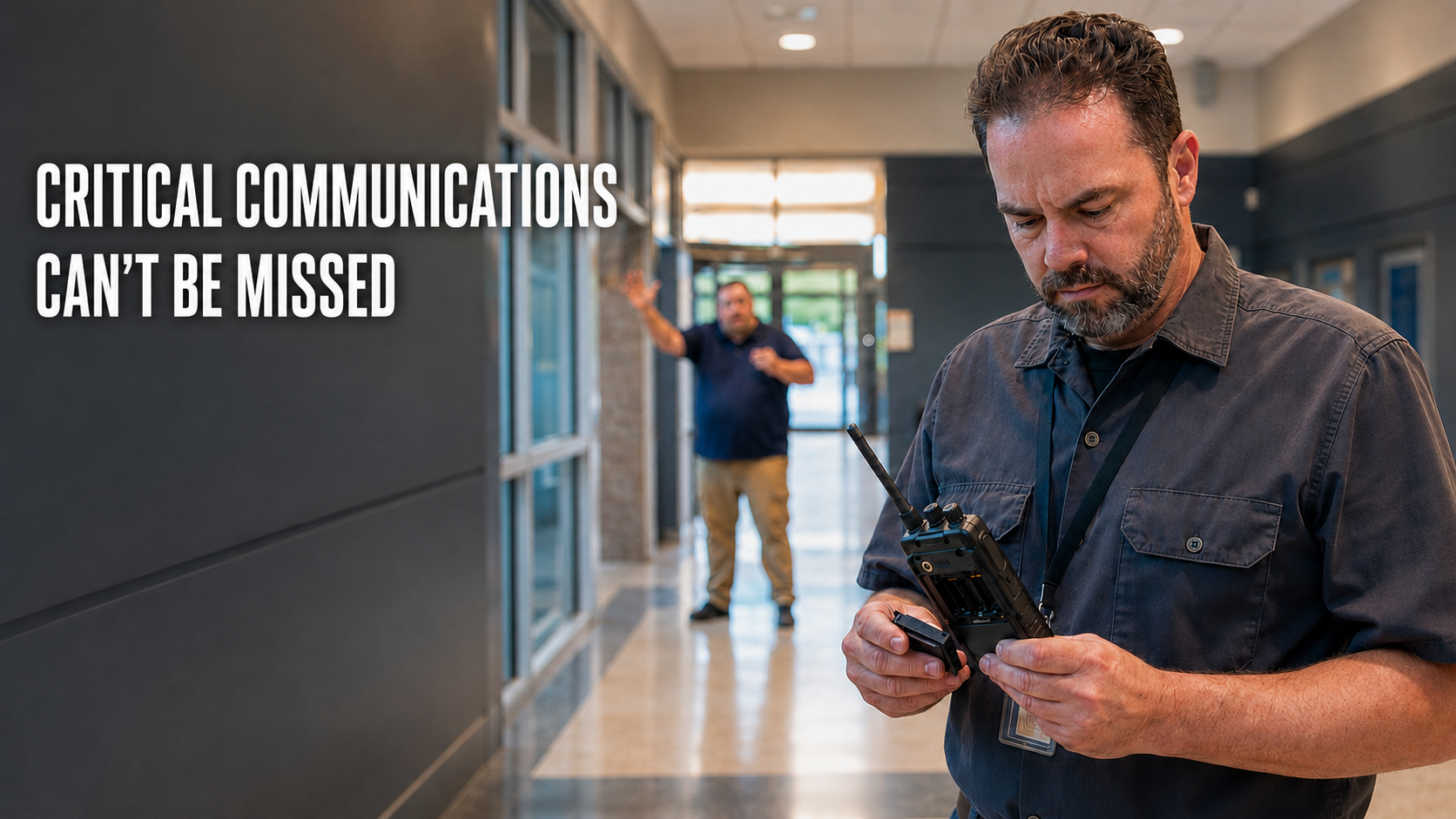
🔋 Keep Your CP200d Fleet Ready for Every Shift
Batteries, chargers, earpieces, speaker mics, and more — everything your team needs to stay connected.
SHOP CP200D ACCESSORIES →What One Missed Radio Call Can Actually Cost You
A radio transmission lasts maybe three seconds. But when that call doesn't go through — because a battery died mid-shift, a speaker mic cable frayed, or a charger stopped making a solid connection — the fallout can drag on for hours.
We're not talking about a minor inconvenience. Depending on your operation, a single missed call can mean a slower emergency response, a guest complaint that turns into a refund, a maintenance issue that compounds into something bigger, or a safety gap that shouldn't have existed in the first place.
Two-way radios exist precisely because your team can't afford to stop, unlock a phone, and wait for someone to pick up. When the radio fails, that whole advantage disappears. If you're evaluating accessories across multiple radio platforms, our Two-Way Radio Accessories Compatibility Guide is a good place to start.
Where the Cost Actually Shows Up
Communication failures tend to hit organizations in four consistent ways:
- Safety: Staff don't receive emergency warnings or requests for backup in time.
- Productivity: Maintenance, security, and operations tasks take longer to coordinate — sometimes requiring multiple follow-up calls to accomplish what one should have.
- Service quality: Guests, students, and customers wait longer than they should for help that was already on the way.
- Reputation: A preventable delay becomes a complaint, a bad review, or a lost account.
The dollar amount varies by organization, but the pattern is consistent. One missed message creates a chain of downstream delays that costs more than the accessory that would have prevented it.
Schools: When Seconds Count, Equipment Can't Be the Weak Link
Think about how many people need to communicate in a school building on any given day — administrators, teachers, security officers, nurses, custodians, bus coordinators, and maintenance staff. During a lockdown, a medical emergency, or a severe weather event, that communication network has to work without hesitation.
The U.S. Department of Education is clear that effective school emergency planning depends on clearly defined staff roles and practiced coordination. A radio that goes dead at the wrong moment — or a microphone that makes transmissions hard to understand — can directly undermine that preparation.
And it's not just emergencies. A custodian who misses a spill report. A nurse who's delayed reaching a student. A maintenance request that requires three follow-up calls. These are the everyday costs of unreliable accessories that rarely get tracked but add up fast.
The hidden cost: slower emergency response, lost staff time, interrupted instruction, and increased risk during critical incidents.
U.S. Department of Education — School Emergency Planning
Hotels: Your Guests Only See the Outcome
Hotel guests don't see the radio calls happening behind the scenes. They see whether their room is ready, whether the maintenance issue got fixed, and whether the staff seemed to have things under control.
When the front desk can't reach housekeeping, a room doesn't turn over on time. When engineering misses a call, a minor HVAC problem becomes a guest complaint. When security can't communicate clearly, incident response slows down in ways that are hard to recover from. Hospitality teams that rely on discreet communication often pair their radios with surveillance kits and covert earpieces to keep staff reachable without disrupting the guest experience.
The American Hotel & Lodging Association consistently finds that cleanliness and service responsiveness are among the top factors driving guest reviews and repeat bookings. Delivering on both requires seamless coordination across departments — and that coordination runs through your radios.
The hidden cost: additional labor, slower room turnover, service recovery expenses, and the kind of guest experience that ends up in a one-star review.
American Hotel & Lodging Association — Industry Trends Report
Events and Venues: There's No Pause Button
Concerts, festivals, conventions, and sporting events run on tight timelines with no margin for communication gaps. Production crews, ushers, security, medical teams, parking staff, and facility personnel may all need to reach each other simultaneously — and they need it to work every time.
CISA's mass gathering security planning framework specifically highlights the importance of identifying communication vulnerabilities before guests arrive. During a live event, a missed radio call can mean a security concern goes unacknowledged, a medical team is delayed, a blocked exit isn't reported, or management is making decisions without accurate information.
The hidden cost: operational delays, safety exposure, overtime, interrupted performances, and reputational damage that follows the event long after it ends.
CISA — Mass Gathering Security Planning Tool
OSHA Has Something to Say About This Too
OSHA's emergency action plan standard requires covered employers to have procedures for reporting emergencies, accounting for employees after an evacuation, and identifying who's responsible for rescue and medical duties. It also requires maintaining an employee alarm system where applicable.
A portable radio isn't a substitute for a properly developed safety plan — but it's often the tool that makes that plan executable in real time. If the radio isn't ready, the plan has a gap. For healthcare environments with specific compliance requirements, see our guide on two-way radio accessories for healthcare.
The hidden cost: confusion during emergencies, duplicated effort, delayed escalation, and difficulty confirming whether everyone is accounted for.
OSHA — Emergency Action Plan Requirements (1910.38)
Buildings Work Against You More Than You Think
Even a well-maintained radio can struggle in certain environments. Building materials, structural design, distance, and interference all affect signal strength — and NIST research has documented significant radio-signal attenuation inside large structures. Stairwells, parking garages, mechanical rooms, and basement areas are common dead zones.
The right accessories won't fix a coverage gap in your system, but they can eliminate the avoidable failures at the user's end of the chain — the dead battery, the loose connector, the earpiece that cuts in and out. For teams operating in high-noise environments, wireless Bluetooth accessories can also reduce cable-related failure points entirely.
NIST — Radio Signal Attenuation Inside Large Buildings
Keeping Your CP200d Fleet Ready
The Motorola CP200d has earned its place in schools, hotels, warehouses, security operations, and event venues because it's straightforward, durable, and supports both analog and digital operation. A lot of organizations have built their communication infrastructure around it — and for good reason.
But even the most reliable radio can't perform with a worn-out battery, a damaged audio accessory, or a charger that no longer makes a solid connection. The radio is only as dependable as the accessories supporting it.
Here's what to keep stocked and maintained:
- High-capacity replacement batteries — Keeps radios operational through long shifts and double shifts without scrambling for a spare.
- Remote speaker microphones — Lets users hear and respond to calls without pulling the radio off their belt every time.
- Surveillance kits and earpieces — Discreet communication for security, hospitality, and event staff who need to hear clearly in active environments.
- Single-unit and multi-unit chargers — Creates an organized charging rotation so radios are inspected, rotated, and ready before each shift.
- Headsets — Hands-free communication for staff who need both hands free on the job.
- Replacement antennas, belt clips, and carry accessories — Keeps the radio protected and positioned where it can actually be heard and reached.
Browse the full lineup: Motorola CP200d Accessories at Waveband Communications
A Five-Minute Readiness Check Before Every Shift
This takes less time than a pre-shift briefing and can catch a failure before it becomes an incident:
- Every radio powers on and shows sufficient battery capacity.
- Each user can transmit and receive clearly — do a quick channel check.
- Speaker microphones, headsets, and earpieces are securely connected and functioning.
- Batteries lock firmly into place with no wobble.
- Antennas and accessory cables show no visible damage or fraying.
- Chargers are working and spare batteries are charged and ready.
- Every user knows the correct channel and the emergency communication procedure.
- Coverage has been tested in stairwells, parking areas, mechanical rooms, and other challenging spots.
Five minutes before the shift starts is a lot cheaper than the alternative.
The Least Expensive Missed Call Is the One You Prevent
You may never know the value of a transmission that gets through without a problem. You'll notice it when one doesn't.
Keeping your CP200d accessories in good shape protects the investment you've already made in your radio fleet. More importantly, it keeps your team reachable when a routine request turns into something urgent — and that's the whole point.
Don't wait for a dead battery or a failed earpiece to expose a gap in your communication plan.