
Shop Professional Charging Solutions
Chargers, Conditioners & Analyzers for Every Radio Platform
Multi-unit gang chargers, vehicle chargers, and conditioning units for Motorola, Kenwood, Harris & more.
Introduction
For law enforcement, fire/EMS, and security agencies, radio readiness is non-negotiable. A radio that goes into a shift with a depleted battery is a liability. Yet charging station setup is one of the most overlooked aspects of fleet management — often improvised rather than designed.
This guide walks through the key decisions involved in setting up a professional radio charging station, from hardware selection to battery rotation protocols, so your fleet is always mission-ready.
Step 1: Assess Your Fleet Size and Shift Structure
Before selecting any hardware, map out your operational requirements:
- How many radios are in your fleet? This determines the number of charging bays you need.
- How many shifts do you run? A 24/7 operation with three 8-hour shifts has different charging needs than a single-shift facility.
- Do you have spare batteries in rotation? Agencies with a 1:1 radio-to-battery ratio need more charging capacity than those running 2:1 or 3:1 spare battery programs.
- Where are radios staged and returned? Charging stations should be located at natural handoff points — locker rooms, dispatch areas, equipment rooms — not in inconvenient locations that discourage proper charging habits.
Step 2: Choose the Right Charger Type
Single-Unit Desktop Chargers
Best for small teams (1–5 radios) or as supplemental chargers at individual workstations. Not practical for fleet-scale deployments due to space and power outlet requirements.
Multi-Unit Gang Chargers
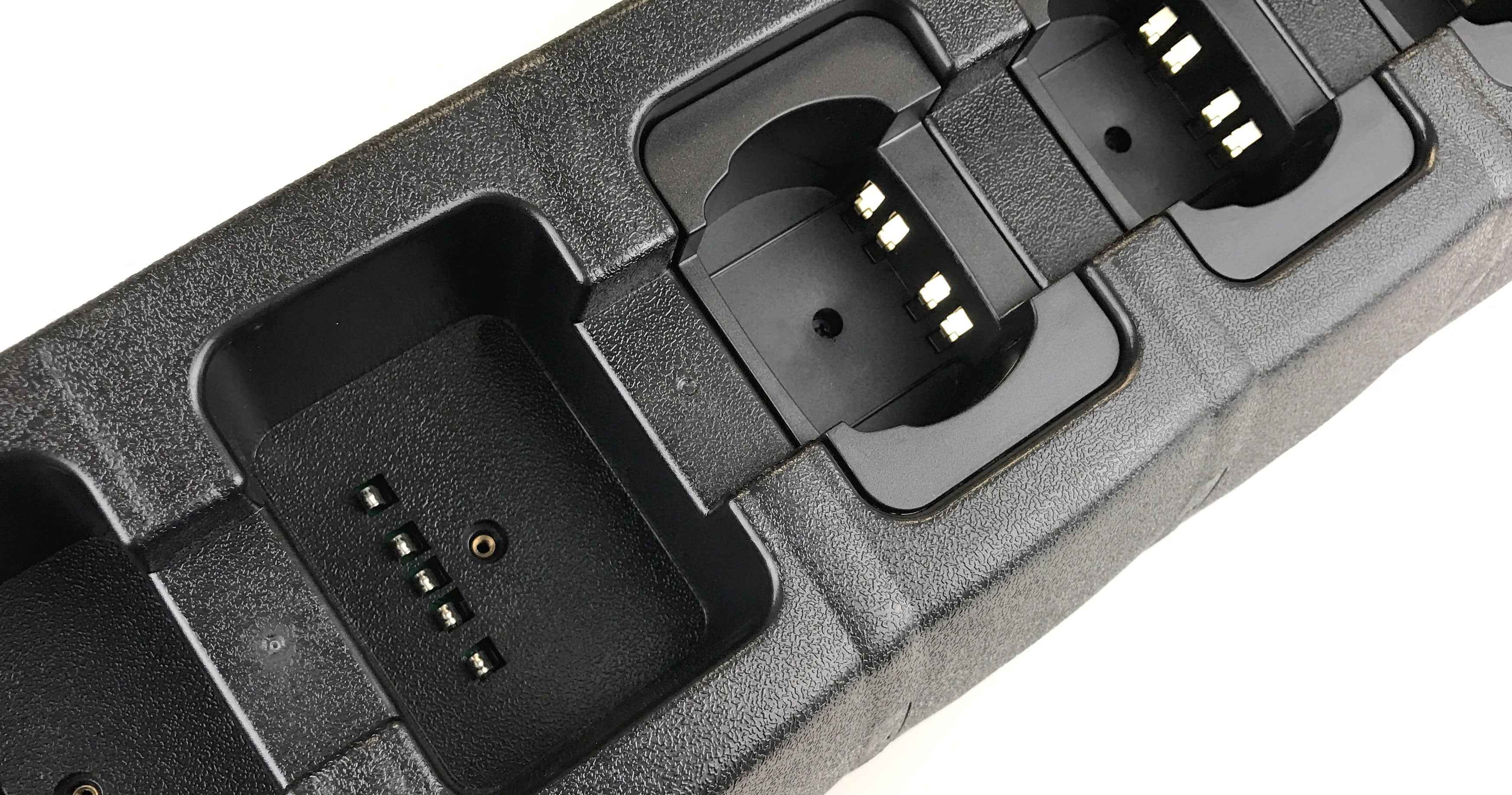
The standard for fleet deployments. Gang chargers typically accommodate 6 radios (or batteries) simultaneously in a single unit with one power connection. Key features to look for:
- Intelligent charge termination: Prevents overcharging by detecting full charge state and switching to trickle or maintenance mode
- Individual bay status indicators: LED indicators per bay allow staff to quickly identify charging status without removing radios
- Compatibility: Verify the charger is rated for your specific radio model — not just the brand
Conditioning Chargers
For NiMH battery fleets, conditioning chargers that perform a full discharge/recharge cycle are essential for preventing memory effect and maintaining rated capacity. Schedule conditioning cycles monthly or per manufacturer recommendation.
Vehicle Chargers
For portable units that spend extended time in vehicles, portable radio vehicle chargers allow batteries to charge during transit — reducing dependence on the base station for top-off charging.
Browse: Two-Way Radio Vehicle Chargers
Step 3: Design the Physical Charging Station
Power Infrastructure
- Each 6-bay gang charger typically draws 2–4A at 120V. Plan your circuit capacity accordingly — a 20-amp dedicated circuit can support 4–6 gang chargers safely.
- Use surge-protected power strips or UPS units to protect chargers from power fluctuations, especially in facilities with heavy electrical equipment.
- Label circuits clearly so facilities staff know not to overload them.
Physical Layout
- Mount chargers at a comfortable working height (counter or shelf level) to make radio placement and retrieval easy during shift changes.
- Allow adequate airflow around chargers — do not stack chargers directly on top of each other or enclose them in tight cabinets without ventilation.
- Position the station near the shift change area to make charging a natural part of the handoff routine.
Labeling and Organization
- Assign specific charger bays to specific radios or officers where possible. This simplifies accountability and makes it easier to identify missing or uncharged units.
- Use asset tags on both radios and batteries to track rotation and identify units due for replacement.
Step 4: Establish a Battery Rotation Protocol
Hardware alone doesn't ensure fleet readiness — you need a documented rotation protocol. Here's a proven framework:
- End-of-shift: Returning officer places radio in assigned charging bay. Supervisor or equipment officer verifies all bays are occupied.
- Pre-shift check: Equipment officer confirms all radios show full charge (green indicator) before issuing. Any radio showing incomplete charge is flagged and a spare is issued.
- Spare battery rotation: Spare batteries are cycled through charging on a defined schedule — not left sitting in chargers indefinitely. Continuous trickle charging degrades Li-Ion capacity over time.
- Monthly conditioning: NiMH batteries are run through a full conditioning cycle monthly. Li-Ion batteries are inspected for swelling, capacity loss, or physical damage.
- Annual replacement review: Batteries showing more than 20% capacity loss vs. rated spec are flagged for replacement. Track battery age by purchase date using asset tags.
Step 5: Common Mistakes to Avoid
- Using the wrong charger: A charger rated for one radio model may physically accept a battery from a similar model but charge it incorrectly, causing damage or reduced cycle life. Always verify model-specific compatibility.
- Leaving batteries in chargers indefinitely: Modern intelligent chargers switch to maintenance mode, but extended storage at full charge still degrades Li-Ion capacity. Remove batteries from chargers if they won't be used for more than a few days.
- Ignoring bay indicator lights: A red or flashing indicator often signals a fault condition — a bad battery, poor contact, or charger issue. Don't ignore these signals.
- Mixing battery chemistries in the same charger: NiMH and Li-Ion batteries require different charging algorithms. Never use a NiMH-only charger with Li-Ion batteries.
- Inadequate spare battery inventory: A 1:1 radio-to-battery ratio leaves no margin for batteries that are charging, being conditioned, or awaiting replacement. A 2:1 ratio is the minimum recommended for 24/7 operations.
Recommended Charging Solutions by Platform
Waveband Communications stocks professional multi-unit chargers for all major radio platforms:
- Motorola XPR 7350 Chargers
- Motorola XPR 7580 Chargers
- Motorola XPR 3500 Chargers
- Kenwood TK3180 Chargers
- Motorola HT750/HT1250 Chargers
Need Help Designing Your Charging Station?
Our team works with public safety agencies, security firms, and industrial operations to spec out complete charging solutions — from single-location setups to multi-site fleet deployments. Contact Waveband Communications for a fleet assessment and volume pricing.